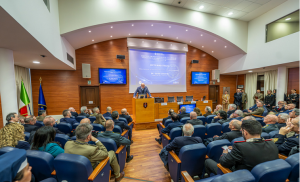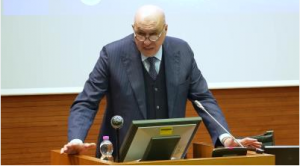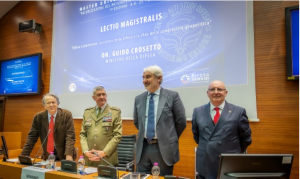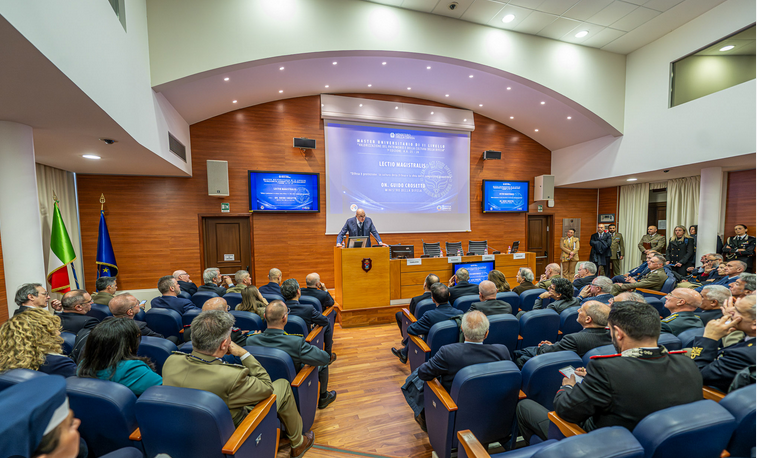
Last week at the Center for Higher Defense Studies (CASD), the Italian Minister of Defence, Guido Crosetto, delivered a lectio magistralis titled ‘Defence is protection: the culture of defense and the challenge of geopolitical complexity.’ Here is the link to the video, followed by Minister Crosetto’s words.
https://www.difesa.it/primopiano/valorizzazione-del-patrimonio-e-della-cultura-della-difesa/95455.html
*****
“I reflected long and hard on the task you entrusted to me today, and I decided to set out my thoughts in writing – one of the rare times in my life that I have done so – because I wanted every word to be carefully weighed. I will therefore try to develop the idea of a “culture of defence,” which you have heard me speak about for the past three years.
I begin with a simple essence, yet one with profound implications, which I can sum up in an apparently banal phrase: defence is protection. Protection of territory, sovereignty, democratic order, and institutional continuity; protection of critical infrastructure, industrial supply chains, energy security, the technological base, the information sphere, and the cognitive domain. Ultimately, defence is the protection of the conditions that make collective freedom possible – the lifeblood of a nation.
From this perspective, Defence goes beyond a merely reactive function in response to threats and physical security, taking on the role of a cornerstone of the national protection system. For a long time, in Europe and across much of the West, a segmented view of defence prevailed: it was assumed that there was a clear divide between economy and power, between development and security, between the civil sphere and the military sphere.
It was often assumed, implicitly, that Defence consisted chiefly in the armed safeguarding of sovereign space and the management of crises in moments of full-blown emergency. History is showing us how fragile that view is. The contemporary international landscape is marked by a form of complexity qualitatively different from the past.
Threats no longer manifest themselves exclusively in a linear and physical way: they are spread across a plurality of domains – military, economic, technological, energy, informational, industrial, cyber, space, and cognitive. Geopolitical fractures also emerge without formal declarations of war.
A state’s vulnerability may take shape long before the outbreak of open conflict. A nation’s defence capacity can be undermined not only by a shortage of means, but also by technological dependencies, industrial fragilities, disinformation, energy vulnerabilities, and the erosion of public trust. Today’s geopolitical system is not simply more unstable: it is structurally more complex. It is so, first and foremost, because of the return of great-power competition, which has brought back to the centre concepts that we may have assumed – perhaps illusorily – belonged to the past: sovereignty, deterrence, industrial capability, strategic autonomy, technological supremacy, and control over critical dependencies.
It is also so because of the growing interdependence between economy and security. Energy, critical raw materials, semiconductors, networks, data, advanced manufacturing capacity, logistics, scientific research, and access to emerging technologies are no longer merely factors of development: they have become factors of power.
It is so because of the centrality of technology: innovation is no longer simply one dimension of security, but a foundational and decisive part of it. Artificial intelligence, space, quantum, cyber, autonomous systems, digital infrastructure, research security, and the speed with which innovation is translated into operational adoption all directly affect the relationship between vulnerability and power. Finally, the system is more complex because of the spread of hybrid threats, which operate below the threshold of open conflict but are no less consequential for that.
Disinformation, cyberattacks, sabotage, economic coercion, pressure on strategic supply chains, and the manipulation of cognitive processes can all produce destabilising effects with systemic repercussions. What is contested today includes markets, resources, and spheres of influence, but also narratives, perceptions, legitimacy, trust, and cohesion. Defence, therefore, cannot be conceived simply as guarding the physical perimeter of a state: that would not be enough.
It concerns the overall resilience of the nation, deep within its vital systems. If this is the nature of our age, then the concept of Defence must be elevated to a broader understanding, one more closely aligned with reality.
Defence is the protection of territory and sovereign space; the protection of the population and republican institutions; the protection of critical infrastructure, energy hubs, communication networks, data, and logistics links. It is the protection of the industrial and technological base, of the state’s decision-making autonomy, of the cognitive sphere, of the quality of public debate, and of democratic trust.
It is the protection of human capital, without which there can be neither innovation nor strategic autonomy. It is the protection of our historical, symbolic, and cultural heritage, which constitutes a source of continuity and national strength. Seen in this light, a culture of defence takes shape as a culture of conscious protection, not as a culture of militarisation. It does not confine its horizon to the use of force – while recognising its necessity – but places it within a broader system in which preparedness, innovation, resilience, administrative capacity, strategic communication, and civic consciousness all converge. It follows that a culture of Defence does not belong exclusively to the Armed Forces: it concerns the entire national community.
It concerns universities, which educate the leadership, researchers, technicians, and citizens of tomorrow.
It concerns industry, because without productive and technological capacity there can be no strategic autonomy. It concerns public administration, because without institutional efficiency there can be no capacity to respond. It concerns the media, because the quality of the information space affects democratic resilience.
It concerns schools, because a sense of institutions is built over time. It concerns the world of culture, because memory, identity, and symbols strengthen national cohesion. And, finally, it concerns citizens: no security strategy is sound unless it is understood, shared, and consciously supported. A mature democracy does not regard a culture of defence as something alien: it recognises it as an essential component of its historical trajectory. This is a genuine paradigm shift. Today, Defence can no longer be placed only at the final stage of crises: it operates before, during, and after them.
Before, through deterrence, preparedness, training, innovation, inter-institutional integration, industrial strengthening, and strategic planning. During, through military intervention, the continuity of essential functions, and a multidomain response. After, through stabilisation, reconstruction, and the analysis of lessons learned and the modeling of a new defense system.
This means that the culture of Defence now coincides with the culture of national preparedness. Preparing does not mean invoking conflict: it means reducing vulnerability, preserving freedom of choice, and making the country better able to face the impact of history.
Allow me, in closing, to return to the basic principle: Defence is protection. Protection of land, sea, sky, space, the digital sphere, and the cognitive domain. Protection of institutions and republican continuity. Protection of critical infrastructure and the country’s vital networks. Protection of the industrial and technological base, of historical memory, and of national identity. Protection of collective freedom. For this reason, speaking today about a Culture of Defense does not mean promoting a culture of war. On the contrary, it means promoting a culture of safeguarding a nation’s material and immaterial heritage.
A nation that knows how to protect itself is a nation that understands its historical moment. And a nation that understands its time is a nation that knows how to prepare itself: freer, more resilient, and more authoritative on the international stage. Thank you.”