Quirinale Palace, 19/12/2025
(Courtesy translation)
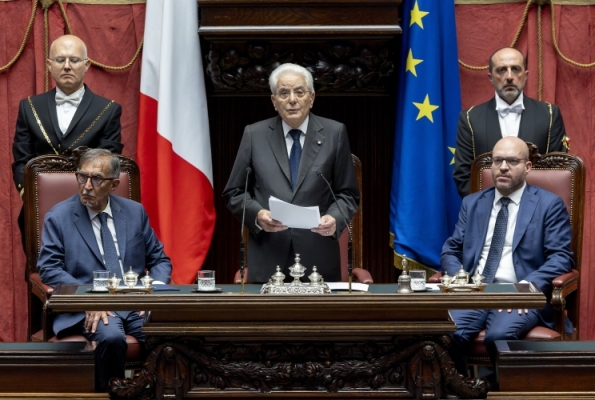
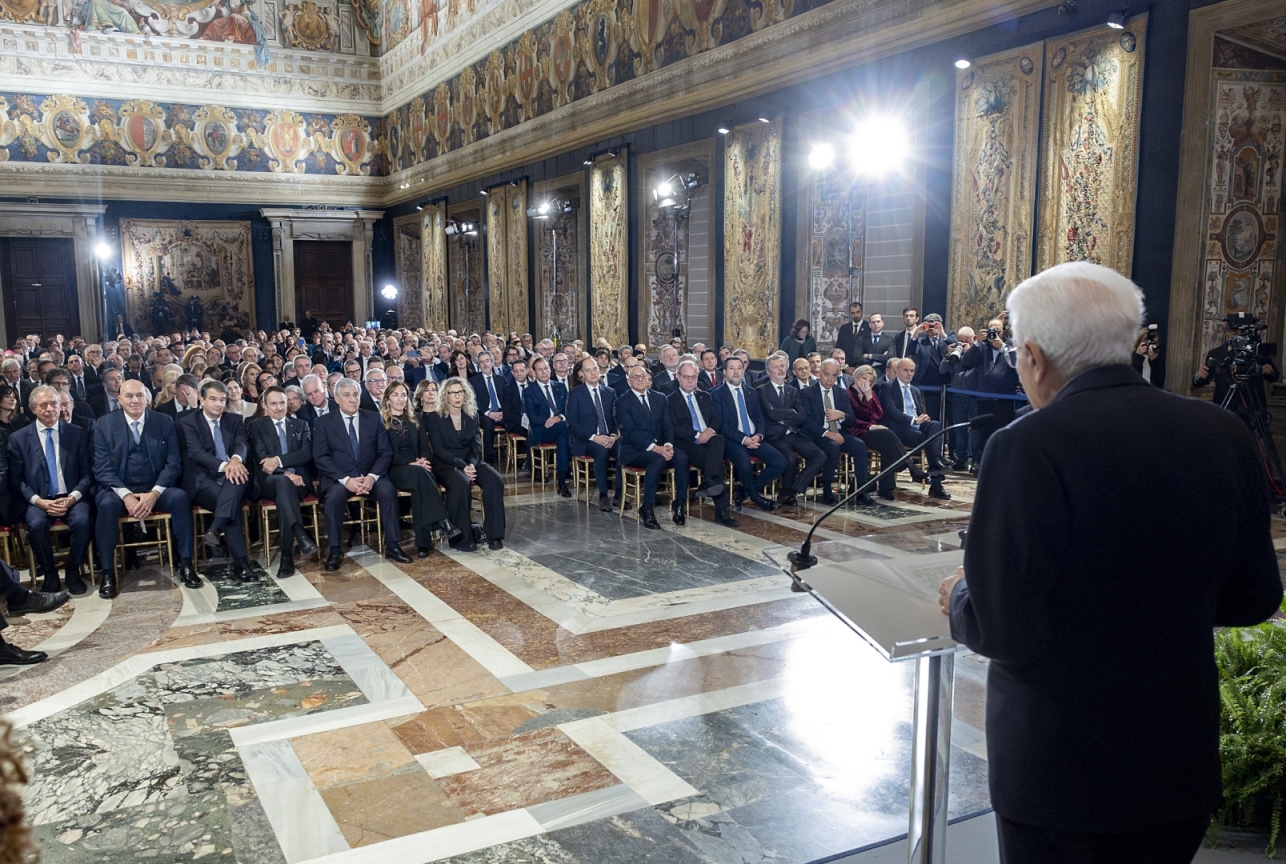
I thank the President of the Senate for his remarks and for his greetings, which I reciprocate with the utmost cordiality, to him and to everyone.
I extend my greetings to the Presidents of the Chamber of Deputies, of the Council of Ministers and of the Constitutional Court, and to all those in attendance.
This traditional end-of-year gathering, with those who hold topmost offices in institutions and others holding responsibilities in various spheres of social life, urges us to look to the future, seeking reasons that may uphold our hope, which is more than a mere ritual expression.
Our common hope today is called peace. A true and just peace everywhere, that may put an end to the uncertainty and confusion the current international situation has brought about.
When it comes to the ongoing conflicts, it is our duty to nurture and consolidate every slight glimmer of hope that opens up, in Ukraine and in the Middle East alike. The goal must be that of building a “permanent peace”, as President Franklin D. Roosevelt defined it when he said: “More than an end to war, we want an end to the beginnings of all wars”.
Peace, therefore, as an affirmation of the rule of law over the rule of arms. Peace as a condition for freedom and development.
Last year marked the 80th anniversary of the Normandy landings: some elderly veterans were present; in their faces and in their eyes I saw pride, as well as the profound meaning of the word peace.
They were there, with their stories, with their wealth of memories, bearing witness to the sacrifice of thousands of young men who came to die in Europe, often far from their homes, to build a new era. An era in which peace was both a prerequisite and a condition for establishing a new civilisation, in freedom.
This is the peace that Europe has built, by fostering transatlantic relations.
This heritage is irreversible, for it has been absorbed by the feelings and consciences of peoples. It must therefore be protected and consolidated, by all possible means.
The space of men and women, where they have the right to choose their own representatives, to monitor and criticise without fearing negative consequences. Where they may read, write and express their thoughts without the risk of repression or pre-emptive censorship. Where they may ensure level conditions for all, regardless of gender, social background, political beliefs, skin colour or religious faith, free from racism and from a resurfacing anti-Semitism. Where there may be an independent judiciary branch. Where decent levels of free healthcare, welfare and solidarity, in times of difficulty, are guaranteed for all.
All this has been delivered through the democratic model. A model that today seems to be challenged by States that are increasingly marked by authoritarian involutions which, contrary to history, are showcasing themselves as alternative models.
Today, another challenge democratic systems must face stems from attempts to ignore and erase the boundary between freedom and arbitrary actions.
The demand to remove limits on individual behaviour, combined with the potential that technology offers, risks overwhelming democratic systems and the rule of law.
There is a lot of talk about the emergence of a new power, deriving from the fact thatimmense financial and technological resources are held by a handful of people, to the detriment of the role institutions representing citizens play. This scenario generates unease, uncertainty and apprehension. Because when political mediation is missing, when there is no possibility of reconciling divergent interests and tensions, communities become divided. Institutions are weakened. Democracies wither. Inequalities grow and the idea of a common destiny too is lost.
Democracy is stronger than its enemies. This is especially true where it has been built with sacrifice. Where it is rooted in the consensus of communities, in people’s convictions, representing the fulfilment of the rights and duties of citizenship.
In the coming year, we will be celebrating 80 years of the Republic.
Eighty years of democracy, development and peace.
What lessons should we draw from what we have achieved, building on the accomplishments of previous generations?
The first value to be emphasised comes from the word “together”: the Republic has lived and continues to live thanks to the contribution of each and every one of us. Thanks to the commitment, sense of duty and sacrifice of every Italian. Thanks to their participation.
“Together” is also the antidote to a lack of faith in the future. “Together” means people. It means participation in collective life.
It is the root of the unity that, through the Constitution, underpins the Republic.
Participation seems an outdated word in an era characterised by growing electoral abstention. In the last regional elections, less than 45 per cent of the eligible voters showed up at the polls. In previous elections, the turnout was already declining, and, alas, we must acknowledge that this is an ongoing trend.
We shall never grow tired of repeating it: a democracy of abstainers, absentees and resigned people is a more fragile democracy, much to the detriment of the citizens themselves. It is everyone’s duty to give this phenomenon some thought while sometimes we get the impression that abstention is a sort of problem that came out of the blue the day before; as if, afterwards, all that matters are the winners and losers, and that everything goes back to normal.
A society that is unaffected when the absolute majority of voters choose not to vote does not realise that it’s becoming less solid, that its politics risks becoming self-referential.
Without such awareness, it would unwittingly help fuel estrangement and a sense of alienation from institutional life. Breaking this vicious circle is in everyone’s interest, given that it is a broad and mindful participation that ensures strong legitimacy.
Above all, we should contemplate the reasons that lead younger voters to forsake the polls. It seldom is a general rejection of politics. Actually, a substantial part of the younger generation has a broad and valuable propensity for civic engagement and mobilisation when it comes to the major issues of our time, from peace to the environment, volunteering and community life. But many choose not to show up at the polls. Investigating the causes of this rejection and exploring the reasons for this mistrust may perhaps allow us to understand how to foster greater participation.
Democracy crucially needs pluralism of ideas, dialectics between different opinions, and discussions between cultural stances that may even be very distant. But when rash categories of friends/enemies prevail over the effort to find shared answers in the collective interest, when society-splitting fractures are created, the seeds of politicalalienation are sown.
From an economic standpoint, the year that is drawing to a close has delivered some positive results.
Employment has been rising and is showing resilience, despite the slow growth of the domestic product, as is the case at the European level.
The government is cautiously keeping public finances under control, which in turn has contributed to a sharp narrowing of the spread, greatly appreciated by international agencies.
The country’s reliability is an asset that has been preserved and must be preserved, in the interest of citizens, businesses and savers. And the higher the public debt burdenis, the more valuable such an asset becomes.
Despite an industrial production slowdown, our companies’ exports still make Italy a world market leader, proving that mutual market opening is beneficial for our economy.
These reassuring figures, and the potential they express, still go with problems and unsolved issues.
Aside from the issue raised by the President of the Senate concerning safety at work, we cannot overlook the situation of over five million people living below the poverty threshold.
While employment among people aged over 50 has soared to high levels, which is encouraging, women’s employment is still below the European average and youth employment is insufficient.
We have the long-standing and serious problem of the real value of wages. Above all, those of people entering the labour market for the first time. And that’s not something new.
Every political side legitimately and necessarily has its own agenda, its own priorities, its own views of reality and of the dynamics that drive it.
But in addition to debate and dialectics – to be expected – there are certain fundamental goals that we all share and require convergence, much to the benefit of Italy.
There are some major issues in national life that transcend the horizon of parliamentary terms and changes in government majorities. These are issues that call for long-term programmes, substantial investments in terms of resources, commitment and sacrifices related to future generations. These strategic issues define the future of our Republic.
The issue of international politics, alliances, and choosing Europe as the path to be unfalteringly followed. And this is not only because of the commitments we have taken on by joining the Treaties.
We are very much aware that the Union has some problems, and many opponents.
Only Europe can preserve and ensure a future to the achievements that Member States, through their legal systems, have guaranteed for decades. There are ever more major problems in our time, which cannot be controlled or resolved by individual states alone.
Not even the richest, largest or most militarily powerful of European country has the capacity, or the presumption, to make it alone in this evolving world.
Even the definition of an accomplished national security strategy requires a concerted effort, now that we are compelled to defend ourselves against new risks which, without baseless scaremongering, are real and present.
Spending on effective tools that ensure collective security has always been unpopular. Understandably. Even when, as in the case in point, the aim is to protect security and peace, within the framework of policies that abide by international law.
And yet, rarely has it been as necessary as it is now – even to crucially contribute to the creation of a common European defence, a deterrent against wars and, concurrently, a safeguard for our shared space of freedom and prosperity.
National security and European security are now inseparable, regardless of how we view the issue of protecting the freedom and development of our societies.
An energy policy that guarantees strategic autonomy calls for shared responsibility. A lot has been done in this regard. The future will require further commitments in terms of both procurement and diversification of sources, without prejudice to the unescapable needs of the ecological transition. This is especially true if we consider the growing demand for energy, partly due to the impact of new technologies and to the extremely high energy demands of Artificial Intelligence systems.
One area where Europe seems to be lagging behind – when it actually could aim to act autonomously – is indeed Artificial Intelligence. Together, the countries of the Union have the necessary resources to create an original, transparent, secure and rights-conscious model of Artificial Intelligence, aimed at developing the areas of excellence that Europe and Italy do not lack.
Similarly, we could mention the plans needed to modernise the infrastructure network, from communications to mobility, as well as the work to be done to finally bring the national water supply network up to standard.
I would also like to draw attention to the demographic issue, with the growing decline in the birth rate. This problem has major social repercussions, and the effects,already visible today, will increase in the medium and long run. The problem is compounded by another phenomenon on the rise: many of our young people – a very large and disquieting figure in the last year alone – are choosing to build their future outside Italy.
These are clearly major issues that affect the national interest on the whole. A joint effort is desirable for identifying areas of convergence and for finding ways to engage the best energies of the country.
We can do it. We know how to do it. We have shown this by putting to good use the resources made available by Europe through Next Generation EU and the National Recovery and Resilience Plan. This important result has also been achieved thanks to the commitment of the governments that succeeded one another.
I said that participation is a vital element that drives the life of our Republic. Everyone’s contribution to the community they belong to is valuable.
Participation also consists of questions, answers, debate and trust in the institutions.
Those who are called upon to represent the institutions, to give them a face and a voice, those who have the honour of serving them, are called upon to meet these expectations and this trust.
The trust of citizens is the most precious resource for the State. It is the groundwork of the constitutional covenant of our coexistence.
This is another reason for expressing the Republic’s gratitude to the women and men who perform their duties on a daily basis, with competence, self-sacrifice, honesty, dignity and honour, in all sectors of public life.
We have administrative bodies and structures of true excellence. They are a real asset and the vast majority of them operate as provided for by the Constitution, ensuring independence, impartiality and a seamless running of state, regional, provincial and municipal offices, in all administrations; not out of loyalty to one side or the other, but out of loyalty to the Republic and its institutions.
I therefore want to thank those who work in the public administration, serving their fellow citizens.
Those who teach and work, devoting their lives to schools and universities.
Those who, in prisons, deal with the reintegration of inmates, namely, prison guards, operators and volunteers.
The doctors, nurses and researchers who tend to people suffering from illnesses with passion and dedication.
Journalists, who guarantee freedom and media pluralism.
Our military personnel, who work with professionalism and sacrifice, at home and abroad, to deliver peace and security.
Law enforcement agencies, who protect our peaceful coexistence.
Those who fulfil their mandate by focusing on the common good of Italy, and not on the following election.
To everyone, our most sincere wishes for a joyful holiday season.
Merry Christmas and a happy 2026.